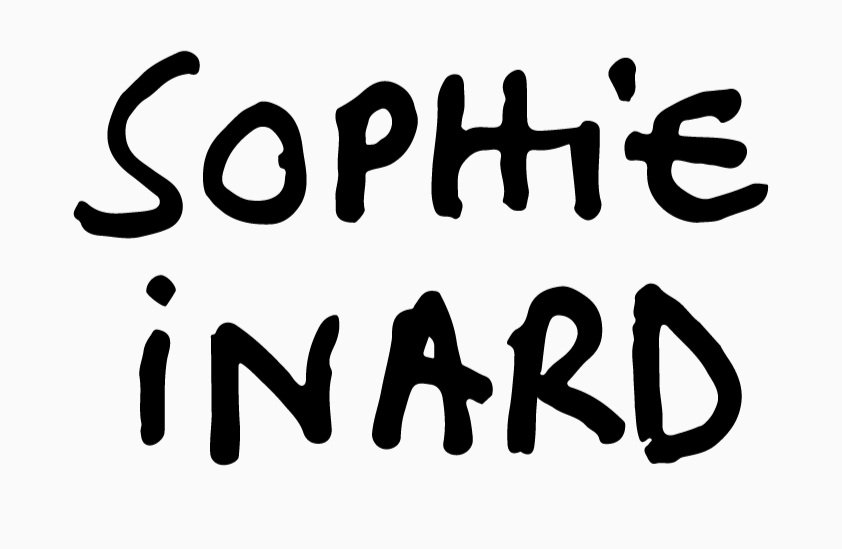
Sophie Inard is a French artist based in Paris.
Her work engages with contemporary icons, weapons, sporting equipment, luxury accessories, which she détournes in order to displace their symbolic narratives.
Drawing from images deeply embedded in our collective cultural memory, she creates objects that oscillate between textile fragility and symbolic power. Her gesture is repetitive and deliberate: to wrap, to cover, to protect. An act of care that reconfigures objects traditionally associated with violence, performance, or spectacle.
By crocheting these signs of power, Sophie Inard disrupts their codes. The object becomes ambiguous, simultaneously familiar and altered, recognizable yet destabilized. A weapon softened, a boxing glove rendered vulnerable, a football made fragile: subtle shifts that generate a sense of the uncanny, where what once felt controlled suddenly appears strange and unsettled.
Her work questions how contemporary societies construct and consume symbols of strength. In a world marked by geopolitical tension and visual saturation, she introduces a form of insistent softness in response to the brutality of dominant imagery. A tension emerges — at times ironic, at times unsettling, always unstable.
Crochet, a technique traditionally associated with intimacy and domesticity, becomes a critical tool. Light in appearance, it acts as a revealer: exposing fractures within symbols, unsettling their authority, and proposing a different way of looking at what our societies elevate as emblems of power.
Her work has been exhibited in France and internationally, notably at the McNay Art Museum (San Antonio, USA) as part of Sport & Spectator (2025), and will be presented at the Nerman Museum of Contemporary Art (Kansas City, June–December 2026). She has also collaborated with institutions and brands such as Merci and Harley-Davidson Paris.
Sophie Inard est une artiste française basée à Paris.
Son travail s’articule autour des icônes contemporaines, armes, objets de sport, accessoires de luxe, qu’elle détourne pour en déplacer les récits et les usages symboliques.
À partir d’images populaires profondément ancrées dans notre mémoire collective, elle façonne des objets qui oscillent entre fragilité textile et puissance symbolique. Son geste est simple, répétitif, presque obstiné : envelopper, recouvrir, protéger. Un acte de care qui transforme notre rapport à des objets traditionnellement associés à la violence, à la performance ou au divertissement.
En crochetant ces signes du pouvoir, Sophie Inard en brouille les codes.
L’objet se fait ambigu : à la fois reconnaissable et altéré, familier et déplacé. Une arme devient douce, un gant de boxe se fait vulnérable, un ballon de football apparaît fragilisé. Ces glissements produisent une forme d’inquiétante étrangeté — ce moment où ce que l’on croyait maîtriser se dérobe et trouble la perception.
Son travail interroge la manière dont nos sociétés construisent et consomment les symboles de force. Dans un monde saturé d’images et marqué par une géopolitique anxieuse, elle oppose une douceur insistante à la brutalité des signes. Une tension affleure : parfois ironique, parfois inquiétante, toujours instable.
Le crochet, technique associée à l’intime et au domestique, devient alors un outil critique. Léger en apparence, il agit comme un révélateur : il met au jour la faille dans le symbole, la déviance de l’objet, et propose une autre manière de regarder ce que notre époque érige comme emblèmes du pouvoir.
Son travail est exposé en France et à l’international, notamment au McNay Art Museum (San Antonio, USA) dans le cadre de l’exposition Sport & Spectator (2025), et prochainement au Nerman Museum of Contemporary Art (Kansas City, juin–décembre 2026). Elle a également collaboré avec des marques telles que Merci et Harley-Davidson Paris.